
Billy Ireland Cartoon Library and Museum lobby by Maria Rimmel, CC BY-SA 4.0, via Wikimedia Commons
Comic Strip, Comic Book, Graphic Novel, Webtoon: A Timeline
Comic strip, comic book, graphic novel, webtoon: four names, one way of telling a story in pictures. Each name arrived at a different moment, and usually later than the thing it describes.
This page dates both. The firsts come from the libraries that keep the originals; the words come from Merriam-Webster, which records the year each is first found in print.
Before the newspapers: Töpffer, 1827
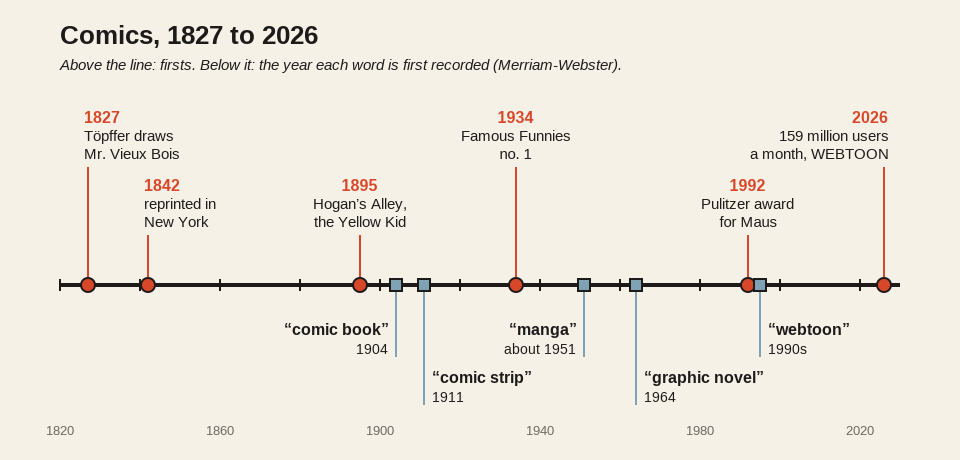
The Swiss artist Rodolphe Töpffer drew his first picture story, Histoire de Mr. Vieux Bois, in 1827 to amuse his friends. Princeton University Library, which holds early copies, calls him a pioneer of the sequential image format we now think of as the comic strip. Goethe admired the drawings. The book was published in 1837 and widely pirated; an English version, The Adventures of Mr. Obadiah Oldbuck, appeared in London in 1841 and was reprinted in New York in 1842 as a supplement to the magazine Brother Jonathan. Princeton files it under the heading "the first comic strip published in America".
The comic strip: the Yellow Kid, 1895
On 5 May 1895 Richard Outcault's Hogan's Alley began in the New York World. Ohio State University's cartoon library, whose digital album holds eighty-eight Yellow Kid pages, describes it as the first commercially successful newspaper comic strip. Its star was Mickey Dugan, better known as the Yellow Kid.
Success brought a fight. In October 1896 Outcault took the Kid to William Randolph Hearst's New York Journal, and Joseph Pulitzer's World had George Luks go on drawing Hogan's Alley, so for more than a year New York had two Yellow Kids. The name came later still: Merriam-Webster first finds "comic strip" in 1911, sixteen years after the thing. Its definition is "a group of drawings in narrative sequence". How those sequences steer the eye is the subject of how to read a comic.
The comic book: 1933 and 1934
A comic book, says the dictionary, is "a magazine containing sequences of comic strips", and the first ones were exactly that: newspaper strips reprinted. In the middle of 1933 came a giveaway called Funnies on Parade; by the end of that year, Comic-Con's columnist Maggie Thompson writes, it had been joined by Famous Funnies: A Carnival of Comics. Michigan State University's comic art collection dates comic books from Famous Funnies no. 1 in 1934. The word is older than the format: Merriam-Webster finds "comic book" in 1904. What a monthly issue costs today, page for page, is in manga vs Western comics in numbers.
Graphic novel vs comic book: the difference
Merriam-Webster defines a graphic novel as "a story that is presented in comic-strip format and published as a book". Set that beside its comic book, a magazine, and the difference is the container, not the art: one is a periodical, the other a book.
W. W. Norton calls Will Eisner's A Contract with God "the first graphic novel" and the book that launched a new art form. The dictionary finds the phrase itself in 1964. The form's best-known honour came in 1992, when the Pulitzer board gave Art Spiegelman a special award "for Maus". Our guide to Maus and the graphic novel takes it from there.
The webtoon: scrolled, not turned
A webtoon, in Merriam-Webster's words, is "a digital comic scrolled vertically": published online, formatted vertically and released in episodes. The word joins web and cartoon and dates to the 1990s; early Korean webcomics were called weptun. It is also the trade name of a leading platform. WEBTOON Entertainment, which calls itself the pioneer of the mobile webcomic format, reported about 159 million monthly active users across its platforms in November 2026 and revenue of $362.8 million for the quarter.
Japan's word has its own date. Merriam-Webster first records "manga" in English around 1951; what manga is and where it came from tells that story.
| Name | What it is, in the dictionary's words | Word first recorded | A first of its kind |
|---|---|---|---|
| Comic strip | a group of drawings in narrative sequence | 1911 | Hogan's Alley, 5 May 1895 |
| Comic book | a magazine containing sequences of comic strips | 1904 | Famous Funnies no. 1, 1934 |
| Graphic novel | a story in comic-strip format published as a book | 1964 | A Contract with God, by its publisher's claim |
| Manga | a comic book or graphic novel of the manga genre | about 1951 | see our manga history |
| Webtoon | a digital comic scrolled vertically | 1990s | early Korean webcomics, called weptun |
The timeline in one table
Every row below comes from a page in the sources at the end.
| Year | What happened | Who records it |
|---|---|---|
| 1827 | Töpffer draws Histoire de Mr. Vieux Bois | Princeton University Library |
| 1837 | The book is published | Princeton University Library |
| 1842 | Reprinted in the United States as Obadiah Oldbuck | Princeton University Library |
| 1895 | Hogan's Alley begins in the New York World, 5 May | Ohio State University |
| 1896 | Outcault moves to the Journal; two Yellow Kids | Ohio State University |
| 1933 | Funnies on Parade, a giveaway of reprinted strips | Comic-Con International |
| 1934 | Famous Funnies no. 1 | Michigan State University |
| 1964 | "Graphic novel" first found in print | Merriam-Webster |
| 1992 | Pulitzer special award for Maus | The Pulitzer Prizes |
| 2026 | 159 million monthly users on WEBTOON's platforms | WEBTOON Entertainment |
Try Three Tonnes of Gold: the Brink's-Mat Robbery
Six men came for the safes and left with three tonnes of gold. The full story of the 1983 Brink's-Mat robbery, Britain's biggest gold robbery, told in pictures. Play it as a case file or read it as a story.
Sources and further reading
Pages we opened when writing this article, last checked 17 November 2026. They open in a new tab, and we are not responsible for what other sites publish.
- The First Comic Strip Published in America (Graphic Arts Collection, Princeton University Library) — Töpffer: drawn 1827, published 1837, pirated, in English 1841, reprinted in the United States 1842.
- The Yellow Kid (Billy Ireland Cartoon Library & Museum, Ohio State University) — Hogan's Alley in the New York World from 5 May 1895, the move to the Journal, the two rival versions.
- Comic strip (Merriam-Webster) — Definition; first known use 1911.
- Comic book (Merriam-Webster) — Definition; first known use 1904.
- Graphic novel (Merriam-Webster) — Definition; first known use 1964.
- Manga (Merriam-Webster) — First known use circa 1951.
- Webtoon (Merriam-Webster, Slang & Trending) — Definition; the word dates to the 1990s; Korean weptun.
- Maggie's World 083: The Depression Comics Challenge (Comic-Con International, Toucan) — Funnies on Parade in mid-1933 and the Famous Funnies titles that followed.
- Development Policy: Comic Art Collection (Michigan State University Libraries) — Comic books dated from Famous Funnies no. 1 in 1934.
- A Contract with God, by Will Eisner (W. W. Norton) — The publisher calls it the first graphic novel.
- Art Spiegelman, 1992 Special Citations and Awards (The Pulitzer Prizes) — The 1992 award "For Maus".
- WEBTOON Entertainment Inc. Reports Third Quarter 2026 Financial Results (SEC filing, 9 November 2026) — About 159 million monthly active users; quarterly revenue of $362.8 million.
This article was drafted with the help of AI and read by a person at Picnic Player, our publisher, before it was published. Automated checks also confirmed that every listed source was opened and every picture is credited. Spotted a mistake? Write to hello@inkhorses.com.
More articles
How to Read a Comic: Panels, Gutters and the Space Between
How comics work, with two diagrams: reading order on Western and manga pages, closure in the gutter, balloons and timing, and an exercise to try.

Maus: A Reader's Guide to Art Spiegelman's Pulitzer Comic
How to read Maus: the two volumes, what to notice page by page, the 1992 Pulitzer, the 2022 Tennessee ban, and where to find a copy.

Manga vs Western Comics: The Differences in Numbers
Manga and Western comics measured: pages, sizes, price per page, credits, how each is serialised and how big the two markets are.