
Ernest Montaut26 by Ernest Montaut (1879–1909), Public domain, via Wikimedia Commons
How Comics Show Motion: Six Techniques, Dated and Tested
A comic panel is a still picture. Nothing in it moves, yet readers see cars race, fists fly and people fall. Cartoonists do it with a small set of tricks, and most of them were borrowed from outside comics: from racing prints, a physiologist's camera and painters who said a running horse has twenty legs.
This guide takes six of those tricks. For each one we found a dated record we could open ourselves, in a museum, a library or a journal. One of the six has even been tested in a laboratory, and we drew one ball six ways so you can compare them.
The six at a glance
Each row names the trick, a dated example and the institution whose own page we read. The sections below follow the same order.
| Technique | A dated example | Whose record we opened |
|---|---|---|
| 1. Lines trailing behind | Ernest Montaut's racing prints, about 1906 | Hagley Museum and Library |
| 2. A streaked background | The same prints; Balla's diagonal ground, 1912 | Hagley; Buffalo AKG Art Museum |
| 3. The same thing, repeated | Marey's fixed-plate camera, about 1882 | Science Museum Group |
| 4. Stretch, lean and dust | Montaut's Renault print, dated 1908 | The print at the top of this page |
| 5. A sound effect | DOOM!, SNAP and KRAKBOOM in Marvel comics | Marvel's own article on its lettering |
| 6. The border itself | Montaut's machines leaving the frame | Hagley Museum and Library |
A panel is not a single moment
The first thing to unlearn is that a panel is a frozen instant, like a snapshot. Scott McCloud's Understanding Comics, a 215-page comic about comics published in 1993, gives a whole chapter, Time Frames, to the point: even one panel shows actions rather than a single moment, lines inside a still picture can stand for motion, and a figure standing still against a blurred background can read as moving too. The reader already expects time inside a still picture, so a few marks are enough to say which way something is going and how fast.
1. Lines trailing behind
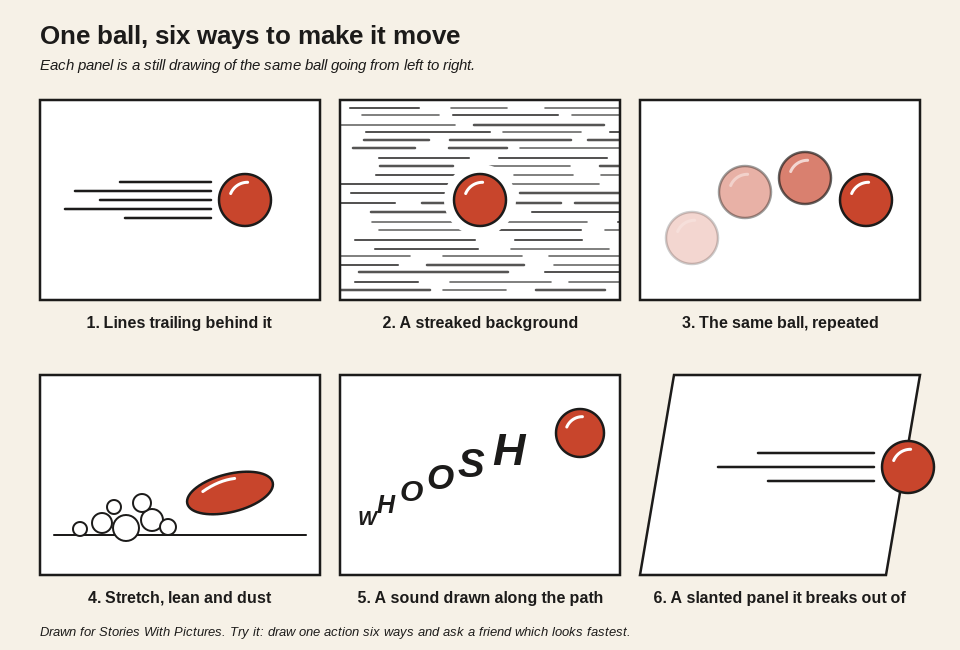
Straight lines behind a moving thing are the best-known trick of all, and a French printmaker usually gets the credit. The Hagley Museum and Library, which owns more than thirty hand-painted lithographs by Ernest Montaut and his wife Marguerite, writes that Ernest "is often credited with originating the technique of adding speed lines behind machines". He died young, in 1909, when the racing cars and aeroplanes he drew were the newest machines of the day.
Do the lines work, or do we only think so? A study published in 2013 by four researchers at the University of Tokyo tested it. Thirty students who had read manga were shown a schematic ball, with or without speed lines on one side, and then had to react to a target. They were quickest when the target appeared on the side the lines said the ball was heading for. When the lines were swapped for other shapes, the advantage for that side disappeared. Their conclusion: adult manga readers do read a direction from a few lines.
2. A streaked background
Instead of putting lines behind the object, you can streak everything else. Hagley notes that the Montauts "borrowed from photographic techniques", leaving parts of the picture out of focus while the car or aeroplane stays crisp. Giacomo Balla did the same in paint in 1912: the Buffalo AKG Art Museum points out that he painted the ground under his dachshund in diagonal lines "to enhance the impression of speed".
Drawing software now has a tool for it. The Clip Studio Paint manual separates speed lines, drawn along a parallel ruler, from focus lines, drawn along a radial ruler so that they point at one spot, and says both are used "to emphasize action, movement, and emotions".
3. The same thing, repeated
Around 1882 the physiologist Étienne-Jules Marey built a camera that recorded a movement in stages on one plate. The Science Museum Group, which keeps it, explains how: a disc with slits turned in front of the lens, and each slit that passed made another exposure. The National Gallery of Art in Washington has one result, a man on a bicycle from about 1885 to 1890, on a glass slide whose image is only 4 by 7.5 centimetres.
Painters took the hint. "A running horse has not four legs, but twenty", five Italian painters wrote in their Technical Manifesto of Futurist Painting in 1910, because "moving objects constantly multiply themselves". One of them, Balla, painted Dynamism of a Dog on a Leash in May 1912 near Siena; the woman's feet, the leash and the dog from nose to tail are, in the museum's words, "blurred and repeated". The same year fellow Cubists tried to keep Marcel Duchamp's Nude Descending a Staircase (No. 2) out of a Paris exhibition. In a comic, a hand drawn three times in one panel does the same job.
4. Stretch, lean and dust
Look at the Montaut print at the top of this page, dated 1908 on its Wikimedia Commons page. The Renault's wheels are drawn as tilted ovals, streaks run along the road and a cloud of dust boils behind the car. No parked car looks like that, which is the point: the distortion is the speed.
It works on anything: tip a runner forward past the point of balance, squash a ball into an egg along its path, add dust or spray. Balla even signed his dog painting at a slant, which the Buffalo museum describes as a dynamic angle.
5. A sound effect
Comics also show movement with words. Marvel's own article on its lettering describes letterers "rendering sounds as onomatopoeia" and picks out three. A giant DOOM! opens Walter Simonson's run on Thor, lettered by John Workman. A small SNAP in The Amazing Spider-Man #121, lettered by Artie Simek, carries what Marvel calls "critical story information" despite its size. And Black Bolt's KRAKBOOM is, Marvel says, at once a sound, a line of dialogue and part of the artwork.
Letter a WHOOSH along the path of a swing, growing as it goes, and it gives the direction as well as the noise.
6. The border itself
Finally, the frame can join in. In many of the Montaut prints, Hagley writes, the vehicle "escapes the frame of the print", as if the artist could not slow it down. Our print has its own version: a swallow drawn outside the picture's edge, keeping pace with the car.
In a comic, slant the panel border or let a fist cross it, and the action looks too big to hold. For speed across several panels rather than inside one, see our guide to sequencing a four-panel strip.
Try it yourself
Our diagram shows one ball drawn six ways. Pick your own action, a kicked ball or a slammed door, and draw it once with each trick. Then ask a friend which looks fastest: the Tokyo experiment in miniature.
If you are just starting, our free tools for a first comic page will get you drawing, and how to read a comic explains the rest of the page around your panel.
Make a strip in Panel Lab
Pick a scene and a hero, write four lines and get a finished four-panel comic you can download. No sign-up.
Sources and further reading
Pages we opened when writing this article, last checked 23 November 2026. They open in a new tab, and we are not responsible for what other sites publish.
- The Montauts' Marvelous Modern Machines (Hagley Museum and Library) — Ernest and Marguerite Montaut's prints: speed lines behind machines, out-of-focus backgrounds, vehicles that escape the frame; Ernest's dates.
- Marey's Camera for Chronophotography, about 1882 (Science Museum Group Collection) — How the fixed-plate camera put the phases of a movement on one plate, and whom the pictures inspired.
- Chronophotograph of a Man on a Bicycle, c. 1885-1890, by Étienne Jules Marey (National Gallery of Art, Washington) — One of Marey's plates: its date, size and public-domain status.
- Technical Manifesto of Futurist Painting, 1910 (text in English) — The painters' own words on moving objects that multiply, and the horse with twenty legs.
- Dinamismo di un cane al guinzaglio (Dynamism of a Dog on a Leash), 1912, by Giacomo Balla (Buffalo AKG Art Museum) — When and where Balla painted it, what is blurred and repeated, the diagonal ground and the slanted signature.
- Nude Descending a Staircase (No. 2), 1912, by Marcel Duchamp (Philadelphia Museum of Art) — The painting's aim and how it was received in Paris in 1912 and New York in 1913.
- Visual Effect of "Speed Lines" in Manga: An Experimental Study on Spatial Attention (Cognitive Studies, 2013) — The University of Tokyo experiment: thirty students, balls with and without speed lines, and what the reaction times showed.
- Speed lines and Focus lines (Clip Studio Paint manual) — What the two kinds of line are for, and the parallel and radial rulers used to draw them.
- "Understanding Comics: The Invisible Art" by Scott McCloud (EBSCO Research Starters) — McCloud's chapter on time within one panel, lines for motion and blurred backgrounds.
- Understanding Comics (Scott McCloud's own site) — The book's date, length and its topic 'time and motion'.
- Ernest Montaut26.jpg (Wikimedia Commons file page) — The description and 1908 date of the Renault print shown at the top.
- Memorable Moments in Marvel Lettering (Marvel, 22 September 2022) — Sound effects as onomatopoeia drawn by letterers: DOOM!, SNAP and KRAKBOOM.
This article was drafted with the help of AI and read by a person at Picnic Player, our publisher, before it was published. Automated checks also confirmed that every listed source was opened and every picture is credited. Spotted a mistake? Write to hello@inkhorses.com.
More articles
How to Read a Comic: Panels, Gutters and the Space Between
How comics work, with two diagrams: reading order on Western and manga pages, closure in the gutter, balloons and timing, and an exercise to try.

Four-Panel Comics: How to Sequence Your Story
Plan a four-panel comic as a sequence of beats, then set the reading path, pacing and transitions so the story reads in the right order.

Free Tools for Drawing Your First Comic Page
Free tools and page setup for your first comic: choose the right size and resolution, then try Krita's built-in comic templates, with trade-offs.