
'Endurance' heeled to port by the ice RMG P00004 by James Francis Hurley, Public domain, via Wikimedia Commons
Shackleton's Endurance in Dates, Days and Distances
On 21 November 1915 Ernest Shackleton stood on a look-out built on drifting ice and watched his ship go down. "She's gone, boys," he said. He had 27 men with him, three small boats, and no way of telling anyone where they were.
Every one of them came home. This page tells how, in dates, days and distances taken from Shackleton's own account, South, published in 1919 and free to read today.
The plan that never started
The Imperial Trans-Antarctic Expedition meant to cross the continent on foot, from the Weddell Sea to the Ross Sea by way of the Pole. Shackleton put the distance at roughly 1,800 miles. The Endurance left South Georgia on 5 December 1914 to land the crossing party. She never reached the coast.
281 days held in the ice
On the morning of 19 January 1915 the ship lay at 76° 34′ south. A survey the next day, Shackleton wrote, "showed that the ship was firmly beset", with ice packed around her as far as the eye could reach from the masthead. She did not move under her own power again.
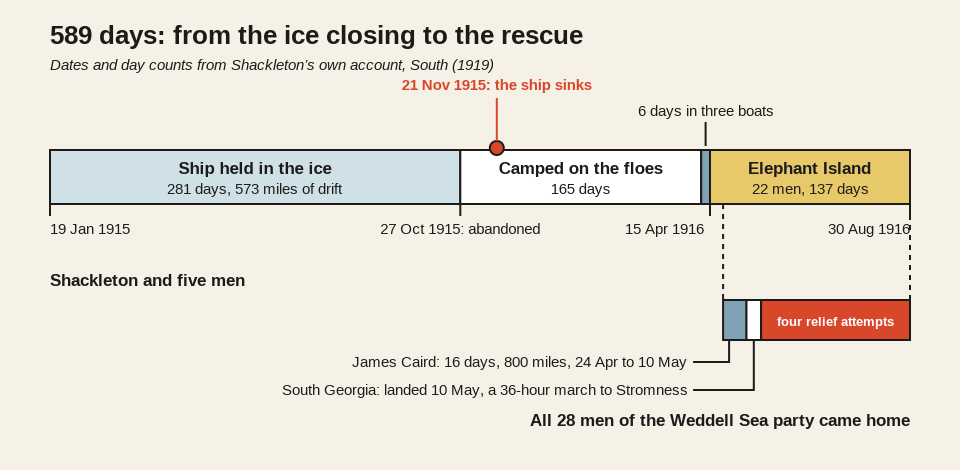
The pack carried her north-west through the polar winter. On 27 October 1915 the pressure broke her, and Shackleton ordered everyone onto the ice. His own count that day: 281 days locked in, 573 miles in a straight line from where she was caught, 1,186 miles through every position observed, and 346 miles to Paulet Island, the nearest place with any hope of food and shelter. Twenty-five days later she sank.
On the floes, then in the boats
Twenty-eight men camped on the moving ice for 165 days, at Ocean Camp and then at Patience Camp, waiting for it to carry them to open water. On 9 April 1916 the floe broke up and they took to the three boats. Six days later, on 15 April, they stood on Elephant Island. A caption in South calls it the first landing ever made there.
Nobody would look for them on that island. Shackleton chose to fetch help himself.
Eight hundred miles in a 23-foot boat
On 24 April he sailed with five men in the largest boat, the James Caird, for the whaling stations of South Georgia, more than 800 miles away across what he called "stormy sub-Antarctic ocean". Fourteen days out they saw the island's black cliffs. They landed on 10 May, on the uninhabited side.
Shackleton, Frank Worsley and Tom Crean then crossed the mountains on foot. They turned out at 2 a.m. on Friday 19 May and, after a march of thirty-six hours, saw the sheds of Stromness whaling station below them. The three men left at the landing place were collected by whalers within days.
Four attempts to get back
Twenty-two men were still on Elephant Island, living under two upturned boats. Shackleton went for them four times. The whaler Southern Sky was at sea by 23 May and was stopped by pack ice. A Uruguayan trawler, the Instituto de Pesca, tried in June. The schooner Emma tried in July. On 25 August he started south a fourth time in the Yelcho, a small steamer lent by the Chilean government and commanded by Luis Pardo.
On 30 August 1916 the Yelcho reached the island. Shackleton called across the water, "Are you all well?" Frank Wild answered, "We are all well, boss." The men had caught 1,436 gentoo penguins to live through the 137 days of waiting.
| Date | What happened | The number |
|---|---|---|
| 5 December 1914 | Endurance leaves South Georgia | 1,800 miles planned on foot |
| 19 January 1915 | Held by the pack ice | 76° 34′ south |
| 27 October 1915 | Ship crushed and abandoned | 281 days, 573 miles of drift |
| 21 November 1915 | Ship sinks | 28 men on the ice |
| 9 April 1916 | The floe breaks; into three boats | 165 days camped |
| 15 April 1916 | Landing on Elephant Island | 6 days in the boats |
| 24 April 1916 | James Caird sails with six men | 800 miles to go |
| 10 May 1916 | Landing on South Georgia | 16 days at sea |
| 19 May 1916 | March across the island begins | 36 hours to Stromness |
| 30 August 1916 | Yelcho reaches Elephant Island | 22 men, 137 days, fourth attempt |
The ship and the boat today
The Endurance was found on 5 March 2022, on day 18 of a search from the South African icebreaker Agulhas II, lying on the sea floor at 3,008 metres, the Falklands Maritime Heritage Trust records. The James Caird survives too: Dulwich College in London, Shackleton's old school, keeps the 23-foot boat on display.
South is in the public domain and free at Project Gutenberg, and its second half tells the less-known story of the Ross Sea party on the far side of the continent. For another true story built from the record, read the 1962 Alcatraz escape as the FBI and Marshals record it or the Brink's-Mat gold robbery.
Try Three Tonnes of Gold: the Brink's-Mat Robbery
Six men came for the safes and left with three tonnes of gold. The full story of the 1983 Brink's-Mat robbery, Britain's biggest gold robbery, told in pictures. Play it as a case file or read it as a story.
Sources and further reading
Pages we opened when writing this article, last checked 17 November 2026. They open in a new tab, and we are not responsible for what other sites publish.
- South: The Story of Shackleton's Last Expedition, 1914-1917, by Sir Ernest Shackleton (Project Gutenberg) — The free edition of the book.
- South, full text (Project Gutenberg) — Every date, position, distance and quoted line of the expedition.
- Third anniversary of Shackleton wreck find (Falklands Maritime Heritage Trust) — The wreck found on 5 March 2022, day 18 of the search, at 3,008 metres, from the Agulhas II.
- The James Caird (Dulwich College) — The boat is 23 feet long and is kept at the college.
This article was drafted with the help of AI and read by a person at Picnic Player, our publisher, before it was published. Automated checks also confirmed that every listed source was opened and every picture is credited. Spotted a mistake? Write to hello@inkhorses.com.
More articles

Alcatraz 1962: The Escape as the FBI and Marshals Record It
The June 1962 Alcatraz escape from the FBI's file and the Marshals' wanted pages: the plan, the night, what was found, the letter and the Dutch raft test.

Brink's-Mat 1983: Where Three Tonnes of Stolen Gold Went
The Brink's-Mat robbery of 26 November 1983 from the record: the raid, the smelting, the convictions, the Panama shell company and the gold still missing.

Maus: A Reader's Guide to Art Spiegelman's Pulitzer Comic
How to read Maus: the two volumes, what to notice page by page, the 1992 Pulitzer, the 2022 Tennessee ban, and where to find a copy.