
Copyright Card Catalog Files by Michael Holley Swtpc6800, Public domain, via Wikimedia Commons
Public Domain Comics in 2026: What Is Free, How to Check
Every 1 January another year of old comics becomes free for anyone in the United States to read, share, reprint and redraw. On 1 January 2026 it was the turn of 1930.
This guide says what arrived, gives the four questions that decide the status of any older American comic, and shows how to answer the hardest one from the libraries' own records. It covers US law only and is not legal advice.
What became free on 1 January 2026
Duke University's Center for the Study of the Public Domain keeps the yearly list. For 1930 its comics and cartoon entries are Betty Boop, from the Fleischer cartoon Dizzy Dishes; Rover, the dog Disney later renamed Pluto; Blondie and Dagwood, from Chic Young's strip Blondie, in which the two are not yet married; and the first week of Mickey Mouse newspaper strips.
The centre adds the caution that matters most. Only the 1930 versions are free. Later, different versions of the same characters are still under copyright, and trademark rights still cover the names and designs when they are used on merchandise.
The four questions
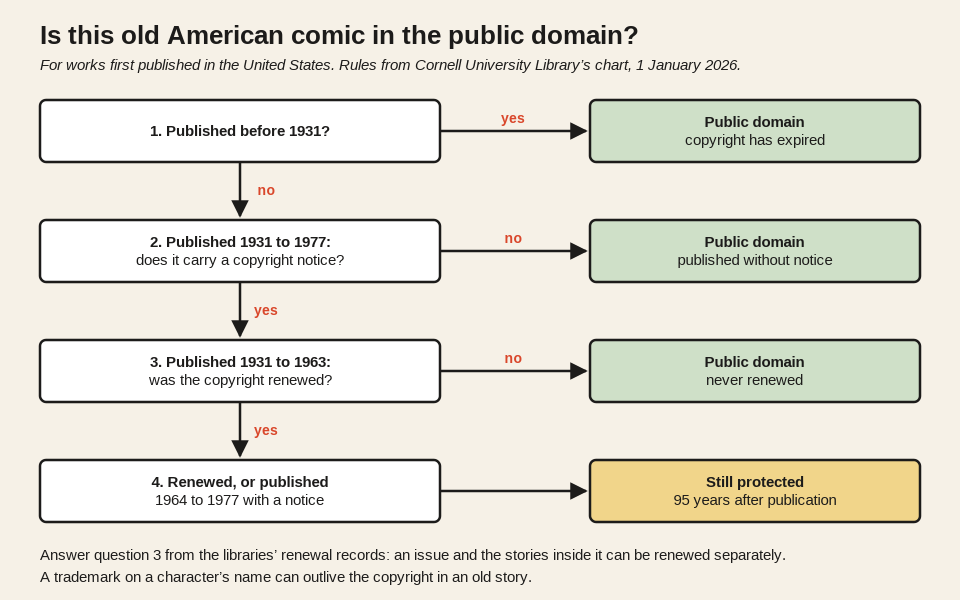
Cornell University Library publishes a chart of the rules and updates it each January. For a comic first published in the United States it comes down to four questions, in order.
First, was it published before 1931? Then its copyright has expired. Second, if it came out between 1931 and 1977, does it carry a copyright notice? Without one it is in the public domain. Third, if it came out between 1931 and 1963 with a notice, was the copyright renewed? If not, it is in the public domain. Fourth, a comic that was renewed, or one published with a notice from 1964 to 1977, is protected for 95 years after publication. Work published from 1978 to 1 March 1989 without a notice, and not registered within five years, is in the public domain too. For work created from 1978 the Copyright Office gives the general rule: the author's life plus 70 years, or 95 years from publication for work made for hire.
The hard question: was it renewed?
Most periodicals published in the United States before 1964 had to renew each issue's copyright after 28 years to keep it, explains The Online Books Page at the University of Pennsylvania. Comic books are periodicals, so the answer for a given series is in the renewal records, and Penn has compiled them into one inventory: for each title, the first issue whose copyright was renewed, if any.
The entries show both outcomes. Action Comics is listed as renewed from June 1938, volume 1 number 1; by the 95-year rule that first issue stays protected to the end of 2033. Batman is renewed from its first issue of spring 1940. For All-Negro Comics the inventory finds no renewal of the issue and none of its contents.
One line in Penn's notes is easy to miss. The stories inside an issue can hold copyrights of their own, apart from the issue's. Animal Comics shows it: no issue renewals, but contributions renewed from early 1943. The same caution covers newspapers, where syndicated strips may still be protected when the paper around them is not.
| Series | What the renewal inventory says | What follows |
|---|---|---|
| Action Comics | Issues renewed from June 1938 (v. 1 no. 1) | Protected; 1938 issues to the end of 2033 |
| Batman | Issues renewed from Spring 1940 (v. 1 no. 1) | Protected; 1940 issues to the end of 2035 |
| Captain Marvel Adventures | Issues renewed from no. 1, 1941 | Protected |
| Animal Comics | No issue renewals; contributions renewed from February-March 1943 | Check each story |
| All-Negro Comics | No issue renewals found; no contribution renewals found | No renewal on record |
| All for Love (1957-1960) | No issue renewals found; no contribution renewals found | No renewal on record |
What stays protected
A free story does not free everything attached to it. The Copyright Office is plain that copyright does not protect names or titles, and equally plain that some names are protected as trademarks. A publisher can therefore still own the name of a character whose first adventure anyone may reprint. And a character changes over the decades: what is free is the character as drawn and written in the free issues, not as it appears today.
Where to read them, and what to do next
Our Free Comics Shelf lists places to read public domain comics, each marked with the kind of free it is. For when comic strips, comic books and graphic novels began, see our timeline of comics; for how the old pages work, how to read a comic.
Before you reprint or adapt anything, run the four questions on the exact issue, look the series up in Penn's inventory, and check the name against trademark records. When a record is missing or unclear, treat the work as protected.
Browse the Free Comics Shelf
Where to read, borrow and make comics for free, each marked with the kind of free it is. Hand-picked and linked straight to the source.
Sources and further reading
Pages we opened when writing this article, last checked 19 November 2026. They open in a new tab, and we are not responsible for what other sites publish.
- Public Domain Day 2026 (Duke Law, Center for the Study of the Public Domain) — The works of 1930 that entered the US public domain on 1 January 2026, and what stays protected.
- Copyright Term and the Public Domain (Cornell University Library, updated 1 January 2026) — The rules by publication date, notice and renewal.
- First copyright renewals for periodicals (The Online Books Page, University of Pennsylvania) — Which comic book series renewed their issues, and from which issue.
- How Long Does Copyright Protection Last? (U.S. Copyright Office) — Terms for works created from 1978 and the renewal rule.
- What Does Copyright Protect? (U.S. Copyright Office) — Names and titles are not protected by copyright and may be trademarks.
This article was drafted with the help of AI and read by a person at Picnic Player, our publisher, before it was published. Automated checks also confirmed that every listed source was opened and every picture is credited. Spotted a mistake? Write to hello@inkhorses.com.
More articles

Comic Strip, Comic Book, Graphic Novel, Webtoon: A Timeline
What separates a comic strip, a comic book, a graphic novel and a webtoon, and when each began: dated from libraries, publishers and the dictionary.
How to Read a Comic: Panels, Gutters and the Space Between
How comics work, with two diagrams: reading order on Western and manga pages, closure in the gutter, balloons and timing, and an exercise to try.

Maus: A Reader's Guide to Art Spiegelman's Pulitzer Comic
How to read Maus: the two volumes, what to notice page by page, the 1992 Pulitzer, the 2022 Tennessee ban, and where to find a copy.